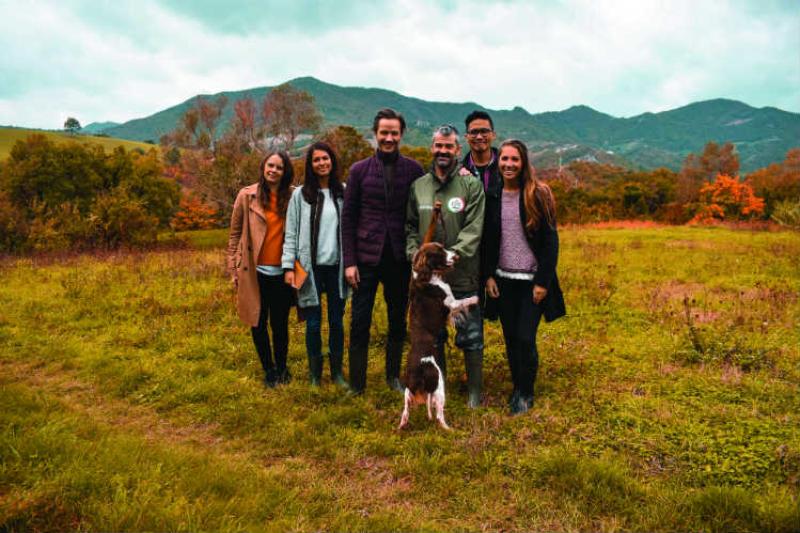
Chicco is delighted to see us when we meet him on a crisp morning in the Italian countryside of Emilia-Romagna. He springs up on to his hind legs to plant a slobbery kiss on his owner’s nose, then greets us by wagging his tail gleefully.
We’re in the woodlands surrounding Sant’Agata Feltria, a sleepy, fairytale village that comes alive during weekends in October when 10,000 tourists descend for its truffle festival.
This morning, we’re joining Chicco the spaniel and his owner Sauro to track down some truffles.
As shafts of sunlight slice through a canopy of oak trees, we follow Chicco through the woods. Suddenly, he sniffs the ground intently, scratching his front legs into the mud and sending soil flying.
Sauro uses a special trowel-like tool called a vanghetto to dig deeper, then plucks a black lump from the soil, giving it a rub before holding it like a prize in his palm.
“It’s been a tough season for truffles this year because of the lack of rain,” Sauro smiles. It makes our discovery feel even more special.
The white truffle is famously more elusive than the black truffle we’ve just found, growing mainly in Italy’s Piedmont, Le Marche and Tuscany areas, as well as here in Sant’Agata.
“Black truffles grow up to 10 centimetres underground, while white truffles can be hidden up to one metre below the earth,” explains Sauro.
Little is known about how or why the white truffle grows. It also has a much stronger scent and flavor compared with the black truffle, making it more expensive.
“Put a white truffle next to a closed egg, or in rice, and it’ll soak up the scent and flavour,” Sauro says.
He is a pizzaiolo (pizza maker) by trade, but truffle hunting is his passion. He explains that the history of the truffle dates back to antiquity, when it was said to have aphrodisiac qualities.
Now truffle hunting is big business – depending on the season, local black truffles can retail at between €600 and €1,400 a kilo, while white truffles sell for between €1,500 and €2,500 per kilo.